
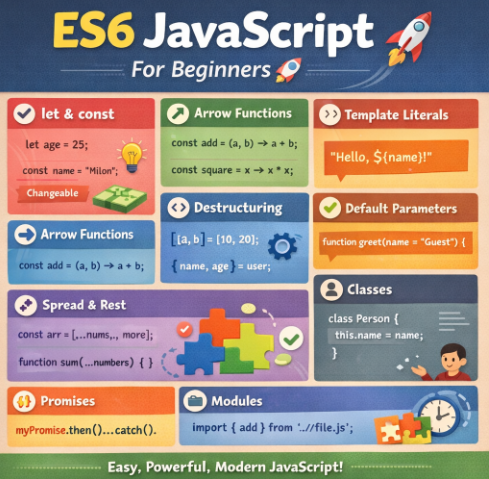
let and const
Before ES6, we used var. Now we use:
let
- Can be changed (reassigned)
- Block scoped
let age = 25;
age = 30;
const
- Cannot be reassigned
- Block scoped
const name = "Milon";
name = "Hasan";
Note: Objects declared with const can still be modified.
const user = { name: "Milon" };
user.name = "Hasan";
Arrow Functions (=>)
Shorter way to write functions.
Normal Function
function add(a, b) {
  return a + b;
}
Arrow Function
const add = (a, b) => {
  return a + b;
};
Short Version
const add = (a, b) => a + b;
Single Parameter
const square = x => x * x;
Template Literals ( )
Use backticks instead of quotes.
const name = "Milon";
const message = `Hello, ${name}! Welcome.`;

console.log(message);
Multi-line strings:
const text = `
This is line 1
This is line 2
`;
Destructuring Assignment
Extract values from arrays or objects easily.
Array Destructuring
const numbers = [10, 20, 30];

const [a, b, c] = numbers;

console.log(a); // 10
Object Destructuring
const user = {
  name: "Milon",
  age: 25
};

const { name, age } = user;
Default Parameters
Set default value if no argument is passed.
const greet = (name = "Guest") => {
  return `Hello ${name}`;
};

console.log(greet()); // Hello Guest
Spread Operator (...)
Used to copy or merge arrays/objects.
Copy Array
const arr1 = [1, 2, 3];
const arr2 = [...arr1];

console.log(arr2);
Merge Arrays
const a = [1, 2];
const b = [3, 4];

const result = [...a, ...b];
Copy Object
const user = { name: "Milon" };
const newUser = { ...user, age: 25 };
Rest Operator (...)
Collect multiple values into an array.
const sum = (...numbers) => {
  return numbers.reduce((total, num) => total + num, 0);
};

console.log(sum(1, 2, 3, 4));
Classes
ES6 introduced classes (OOP style).
class Person {
  constructor(name, age) {
    this.name = name;
    this.age = age;
  }

  greet() {
    return `Hi, I am ${this.name}`;
  }
}

const person1 = new Person("Milon", 25);
console.log(person1.greet());
Inheritance
class Student extends Person {
  constructor(name, age, subject) {
    super(name, age);
    this.subject = subject;
  }
}
Promises
Handle asynchronous operations.
const myPromise = new Promise((resolve, reject) => {
  let success = true;

  if (success) {
    resolve("Success!");
  } else {
    reject("Error!");
  }
});

myPromise
  .then(result => console.log(result))
  .catch(error => console.log(error));
Modules (Import / Export)
Split code into multiple files.
Export (file1.js)
export const name = "Milon";

export const add = (a, b) => a + b;
Import (file2.js)
import { name, add } from './file1.js';

console.log(name);
New Data Structures
ES6 introduced new built-in structures.
Set (Unique Values)
const numbers = new Set([1, 2, 2, 3]);

console.log(numbers); // 1,2,3
Map (Key-Value Pairs)
const user = new Map();

user.set("name", "Milon");
user.set("age", 25);

console.log(user.get("name