As AI models become more capable, advanced prompt engineering helps maximize output quality, consistency, and reliability. This guide explores professional techniques used by developers, researchers, marketers, and AI specialists.
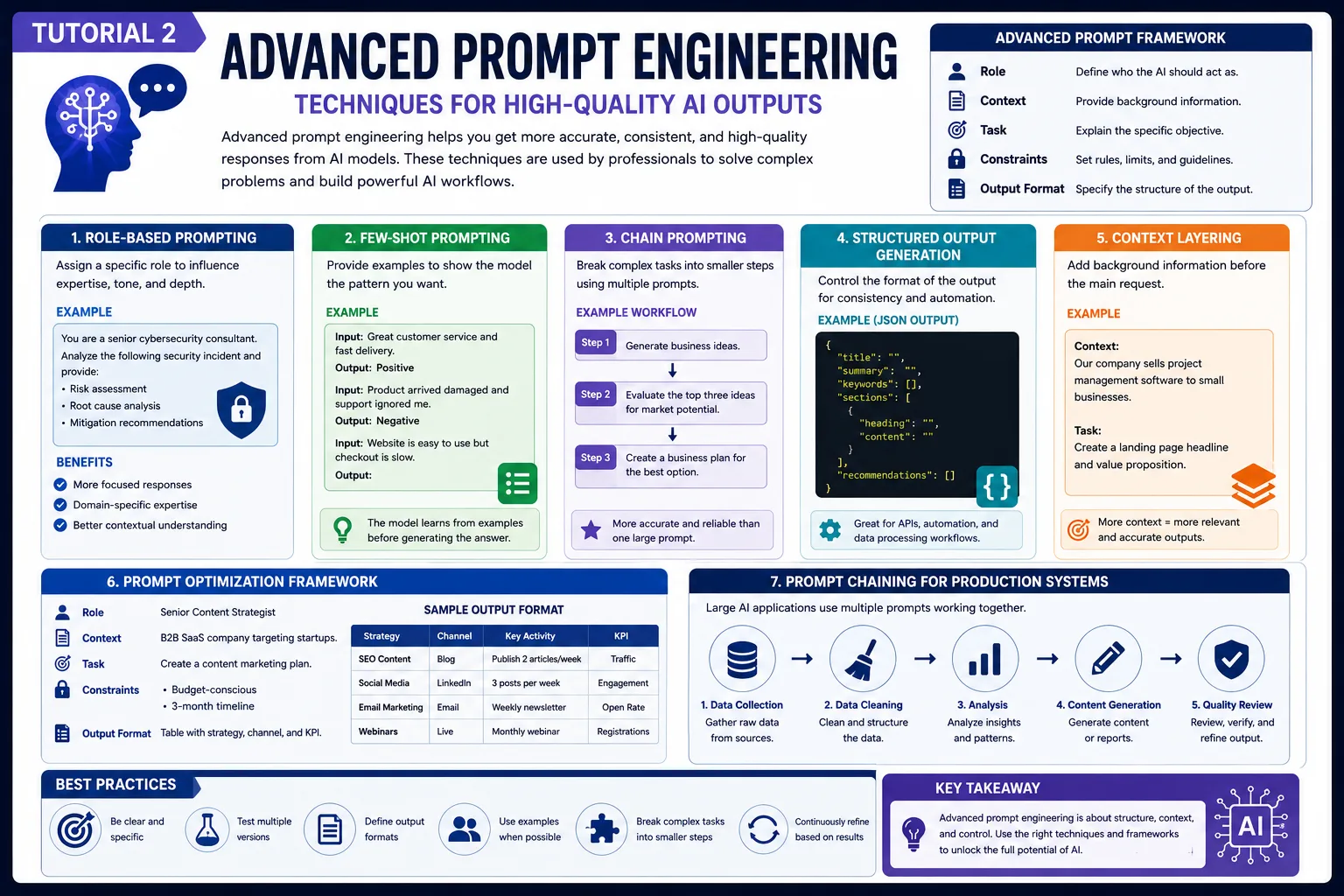
1. Role-Based Prompting
Assign a specific role to influence expertise and communication style.
Example
You are a senior cybersecurity consultant.

Analyze the following security incident and provide:
- Risk assessment
- Root cause analysis
- Mitigation recommendations
Benefits:
- More focused responses
- Improved domain-specific language
- Better contextual understanding
2. Few-Shot Prompting
Few-shot prompting provides examples that demonstrate the desired pattern.
Example
Input: Great customer service and fast delivery.
Output: Positive

Input: Product arrived damaged and support ignored me.
Output: Negative

Input: Website is easy to use but checkout is slow.
Output:
The model learns from examples before generating its answer.
3. Chain Prompting
Break complex workflows into smaller prompts.
Workflow Example
Step 1
Generate business ideas.
Step 2
Evaluate the top three ideas.
Step 3
Create a business plan for the best option.
This method often produces more accurate results than a single large prompt.
4. Structured Output Generation
Control response format using templates.
Example
{
  "title": "",
  "summary": "",
  "keywords": [],
  "recommendations": []
}
Structured outputs improve automation and data processing workflows.
5. Context Layering
Provide background information before the main request.
Example
Context:
Our company sells project management software to small businesses.

Task:
Create a landing page headline and value proposition.
More context often leads to more relevant outputs.
6. Prompt Optimization Framework
A powerful framework includes:
Role
Who the AI should act as.
Context
Relevant background information.
Task
The specific objective.
Constraints
Rules and limitations.
Output Format
Expected structure.
Example
Role:
Senior Content Strategist

Context:
B2B SaaS company targeting startups.

Task:
Create a content marketing plan.

Constraints:
- Budget-conscious
- 3-month timeline

Output:
Table with strategy, channel, and KPI.
7. Prompt Chaining for Production Systems
Large AI applications often use multiple prompts working together.
Example Workflow
- Data Collection
- Data Cleaning
- Analysis
- Content Generation
- Quality Review
This architecture improves scalability and consistency.