AI Data Centers Are Consuming More Natural Resources Than Ever Before
A common belief in the technology industry is that as technology becomes more advanced, efficient, and compact, it requires fewer resources. However, the rapid rise of artificial intelligence (AI) is challenging that assumption. Behind every AI-powered application lies a vast network of data centers, servers, and computing infrastructure that consume enormous amounts of electricity, water, and land.
According to a recent report from the United Nations University (UNU), the continued expansion of AI data centers could significantly increase global demand for critical natural resources by 2030. The report warns that without sustainable planning and cleaner energy solutions, AI infrastructure may place unprecedented pressure on the environment.
AI Cooling Systems Require Massive Amounts of Water
AI data centers operate around the clock, processing billions of requests and calculations every day. As servers run continuously, they generate substantial amounts of heat that must be controlled to maintain performance and prevent hardware failures.
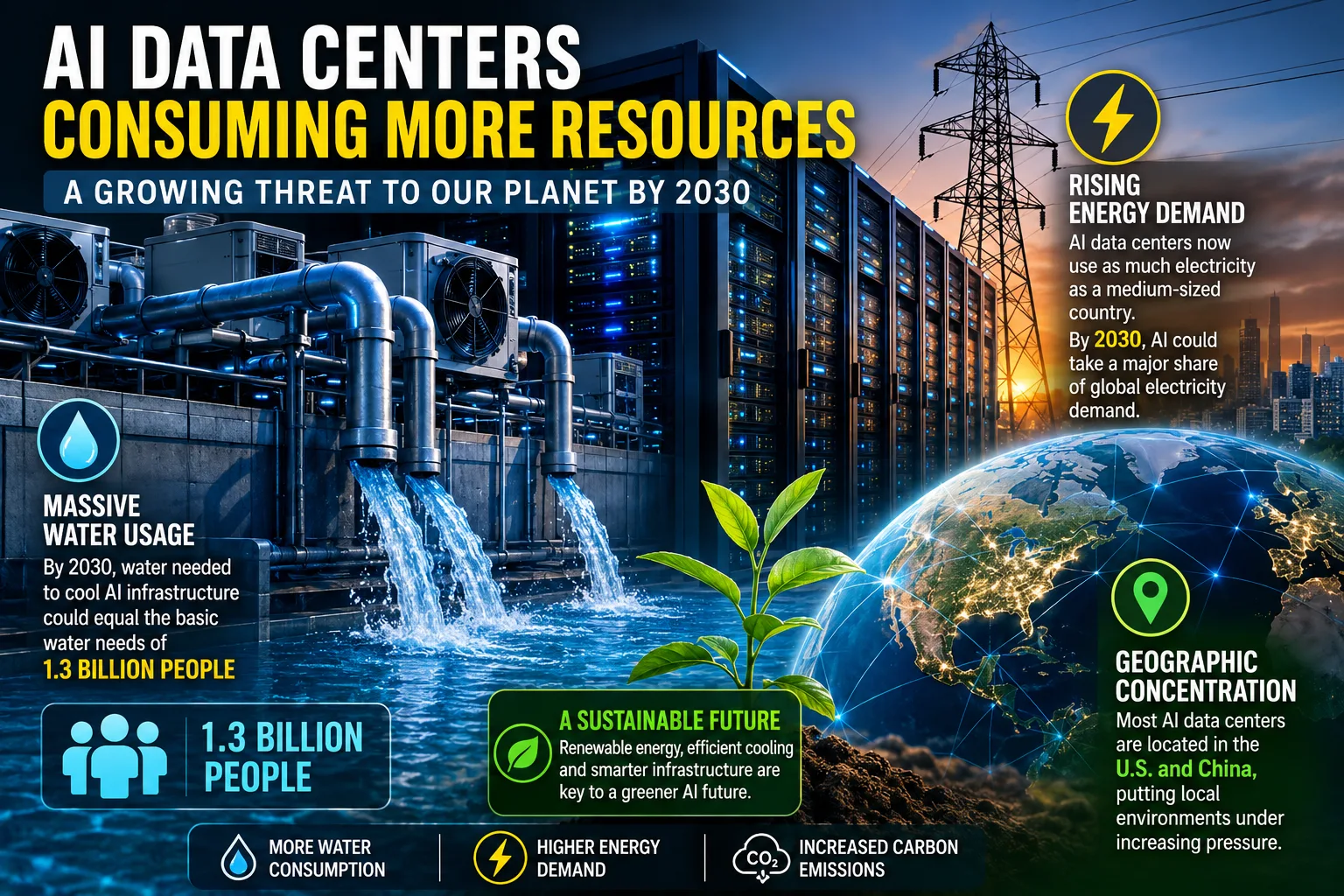
To manage this heat, data centers rely on sophisticated cooling systems, many of which require large quantities of clean water. The UNU report estimates that if current AI growth trends continue, the amount of water needed to cool AI infrastructure by 2030 could be comparable to the basic water requirements of approximately 1.3 billion people worldwide.
This growing demand raises concerns about water availability, particularly in regions already facing droughts, water scarcity, and climate-related challenges.
AI Data Centers Are Becoming Major Energy Consumers
The energy footprint of AI is expanding just as rapidly as its water consumption. Today, AI data centers collectively consume electricity on a scale comparable to that of a medium-sized country.
The increasing popularity of AI-powered tools, chatbots, virtual assistants, and AI image-generation platforms is driving a sharp rise in computing demand. Every user query, generated image, and machine-learning task requires significant processing power, leading to higher electricity consumption across global data center networks.
Experts warn that by 2030, AI infrastructure could account for a substantial share of worldwide electricity demand, making energy efficiency and renewable power adoption critical priorities for the technology sector.
Geographic Concentration Creates Environmental Challenges
The report also highlights the uneven distribution of AI infrastructure across the globe. A large proportion of the world's AI data centers are concentrated in the United States and China, where much of the environmental burden associated with AI development is experienced.
While users around the world benefit from AI technologies, the environmental impacts—including increased energy consumption, water use, and land requirements—are often concentrated in specific regions that host these facilities.
This imbalance has sparked discussions about environmental responsibility, resource management, and the need for more sustainable approaches to AI deployment worldwide.
The Need for Sustainable AI Development
As artificial intelligence continues to transform industries and everyday life, experts emphasize the importance of balancing innovation with environmental sustainability. Expanding the use of renewable energy sources, improving cooling technologies, increasing energy efficiency, and developing greener data center infrastructure could help reduce AI's environmental footprint.
Without significant investments in sustainable solutions, the rapid growth of AI data centers may contribute to higher carbon emissions, greater pressure on freshwater resources, and increased strain on global energy systems.
The findings from the United Nations University serve as a reminder that the future of AI depends not only on technological advancement but also on responsible resource management and environmental stewardship.
Conclusion
Artificial intelligence is reshaping the digital world, but its infrastructure comes with substantial environmental costs. From massive water consumption for cooling systems to soaring electricity demand and rising carbon emissions, AI data centers are becoming one of the most resource-intensive components of the modern technology ecosystem. As the industry continues to expand, sustainable innovation will be essential to ensuring that AI growth does not come at the expense of the planet.
Source: United Nations University (UNU) Report and Times of India.