Can AI Translate Animal Languages? Scientists Are Decoding Whale Songs, Dolphin Signals, and More
For decades, the idea of talking with animals has been a fascinating concept in science fiction. Imagine having a conversation with a whale, asking a dolphin how it feels, or understanding the hidden messages within a bird's song. Thanks to the rapid advancement of artificial intelligence (AI), these possibilities are moving closer to reality.
Researchers around the world are now using AI-powered technologies to analyze animal sounds, behaviors, and communication patterns. While fully translating animal languages remains a significant scientific challenge, experts believe AI could eventually help establish limited two-way communication between humans and certain animal species.
How AI Is Transforming Animal Communication Research
Artificial intelligence has become a powerful tool for studying animal communication. Modern AI systems, particularly those based on artificial neural networks, can process enormous amounts of data and identify patterns that would be nearly impossible for humans to detect manually.
Scientists are collecting and analyzing vast libraries of animal sounds, movements, and interactions. By applying machine learning algorithms, researchers can uncover relationships and structures within animal communication systems that were previously hidden.
One of AI’s greatest strengths is its ability to recognize subtle patterns across large datasets. This capability is helping scientists gain deeper insights into how animals communicate with one another in their natural environments.
AI Helps Decode Signals from Whales, Dolphins, Birds, and More
Recent years have seen significant progress in the study of communication among various species, including:
- Whales
- Dolphins
- Birds
- Primates
- Cuttlefish
- Rodents
Researchers are using AI to analyze different vocalizations, unique sound signatures, and complex communication behaviors. Many of these signals may carry specific information or messages.
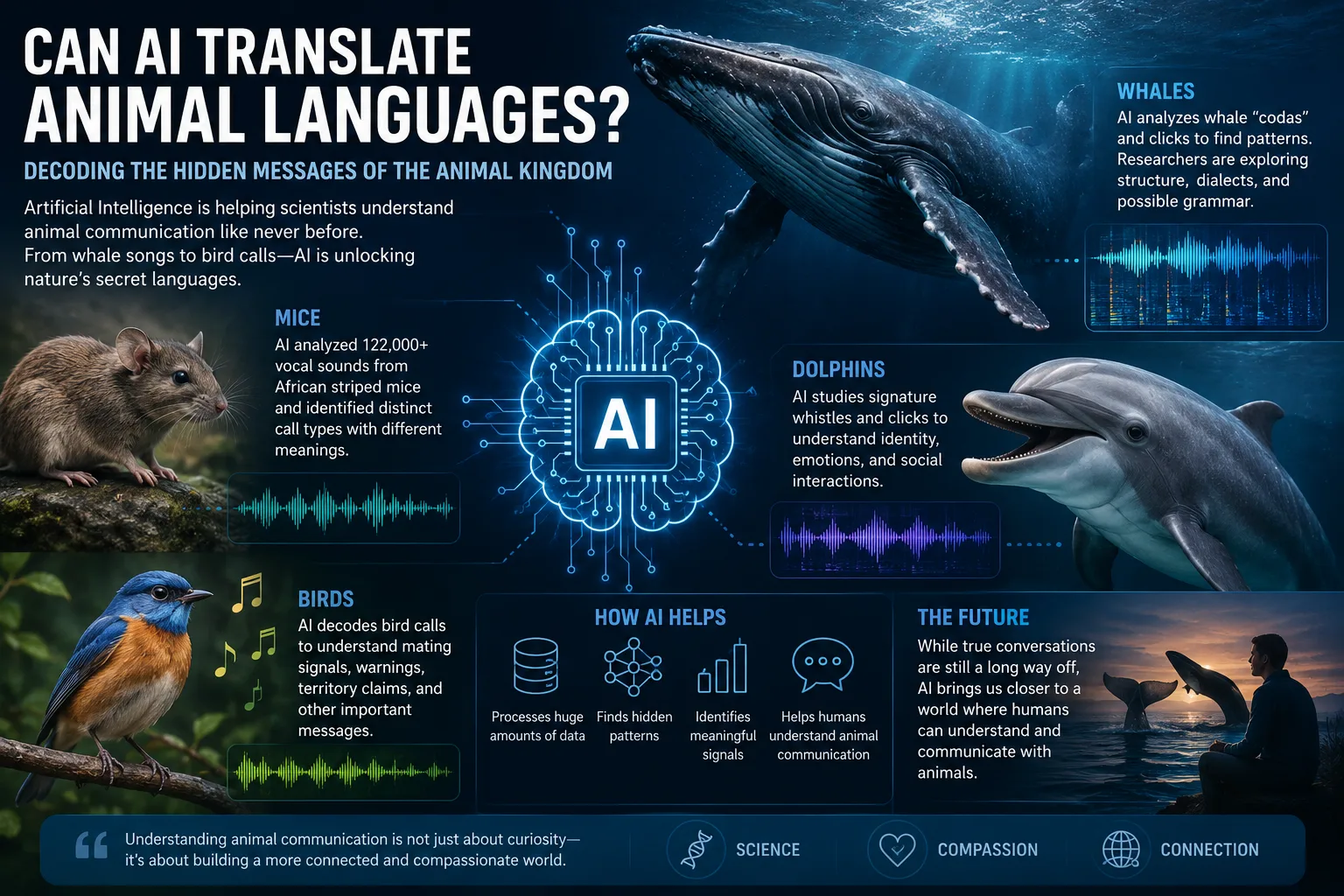
In one notable study, scientists examined more than 122,000 vocal sounds produced by African striped mice. Using AI-powered analysis, they successfully identified several distinct call types, suggesting that these sounds may serve different communicative purposes.
Similar projects are currently underway involving dolphins, whales, birds, and non-human primates, with the goal of understanding how these animals exchange information.
Can AI Reveal a Hidden Structure in Whale Communication?
One of the most exciting areas of research focuses on whale communication, particularly the study of “codas” — sequences of clicking sounds produced by certain whale species.
Scientists are investigating whether these clicks contain structures similar to elements found in human language. Researchers are exploring questions such as:
- Do whale sounds function like words?
- Are there different dialects among whale populations?
- Can whales use unique sounds to identify individuals?
- Is there a form of grammar or syntax within whale communication?
Early findings suggest that whale communication may be far more sophisticated than previously believed. AI is helping researchers uncover patterns that could reveal complex social and informational exchanges among whales.
Why Translating Animal Communication Is So Difficult
Although AI can identify patterns and potential meanings within animal signals, translating those signals into human language is an entirely different challenge.
Animals experience and interpret the world in ways that differ greatly from humans. Their senses, environments, and social structures shape communication methods that may not have direct human equivalents.
Even if researchers can determine the probable meaning of a specific sound or signal, accurately conveying an animal's experience, emotion, or intent remains extremely difficult.
For this reason, most scientists avoid claiming that they are “translating animal languages.” Instead, they focus on understanding the structure, function, and context of animal communication systems.
The Future of Human-Animal Communication
As AI technology continues to evolve, researchers are optimistic about gaining a deeper understanding of how animals communicate. Advanced machine learning models may eventually allow humans to interpret certain animal signals with greater accuracy and perhaps even respond in meaningful ways.
While true conversations with whales, dolphins, or birds may still be years away, AI is opening new doors in the study of animal intelligence and communication. These breakthroughs could transform our understanding of the natural world and strengthen the connection between humans and other species.